Beneath the vibrant surface of Pixar’s Inside Out lies a profound exploration of the human psyche, beautifully visualized through its unforgettable cast of characters. This Inside Out Characters & Emotions Analysis isn't just a breakdown of who's who; it’s an invitation to understand the intricate dance of feelings that shapes our inner world and, crucially, how acknowledging every emotion leads to a richer, more resilient self.
Pixar didn't just tell a story; they gave us a masterful allegory for emotional development, wrapping complex psychological concepts in a package so engaging, even children grasp its truths. By dissecting the film’s central figures, we uncover timeless lessons about empathy, self-acceptance, and the vital role every single feeling plays in our lives.
At a Glance: Key Takeaways from Inside Out
- Emotions are not good or bad, but functional: Every emotion, even sadness or fear, serves a critical purpose in our well-being.
- Emotional balance is key: True happiness isn't the absence of sadness, but the ability to feel and integrate all emotions.
- Childhood development is complex: Growing up involves letting go of old comforts (like imaginary friends) and embracing new emotional capacities.
- The power of empathy: Understanding and expressing sadness is crucial for connecting with others and receiving support.
- Parents play a mirroring role: Riley's parents' emotional states subtly influence her own, highlighting the importance of family emotional dynamics.
The Command Center: Meet Riley’s Inner Architects
At the heart of Inside Out is Riley Andersen, a seemingly ordinary girl whose mind becomes the extraordinary stage for an internal drama. Her emotions aren't just background elements; they are the main characters, each with distinct personalities, motivations, and evolving roles. They operate from Headquarters, a vibrant control room in Riley’s mind, dictating her reactions and shaping her reality.
This anthropomorphic representation offers a brilliant framework for developing emotional intelligence, showing us that our feelings aren’t random occurrences but active agents working—sometimes haphazardly—to navigate our world.
Joy: The Relentless Optimist Turned Wise Leader
Archetype: Hero / Protagonist
Key Trait: Optimistic, Energetic
Motivation: To ensure Riley is always happy, initially perceiving all other negative emotions as harmful distractions.
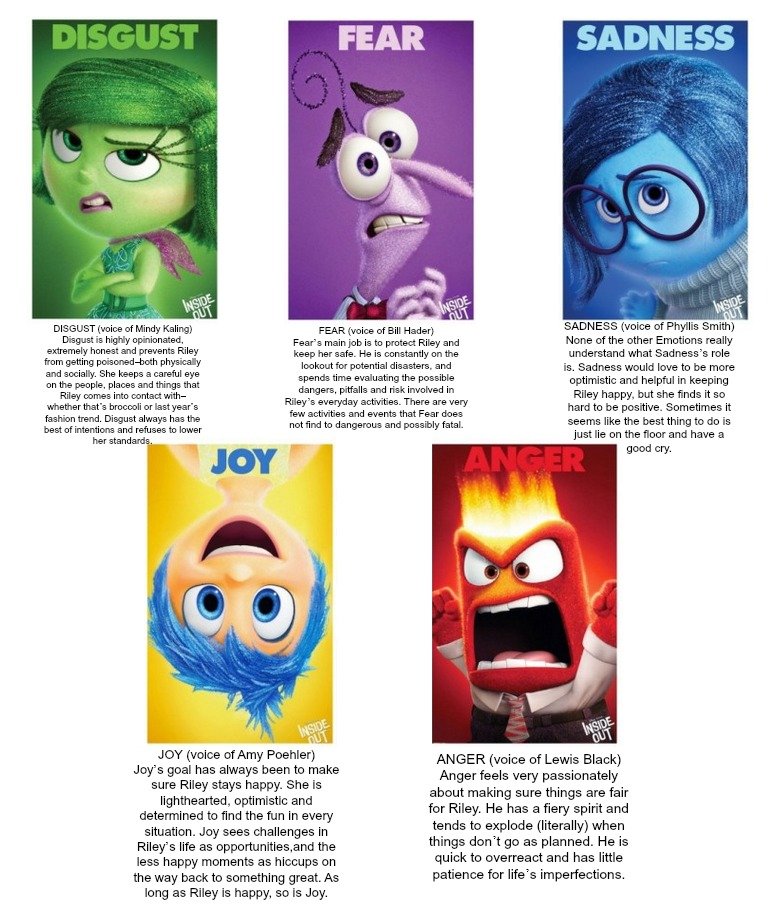
From the moment she sparks into existence, Joy is the driving force of Riley's mind. Voiced with infectious enthusiasm by Amy Poehler, she is the embodiment of pure, unadulterated happiness. Her initial mantra is simple: "Keep Riley happy!" This goal, while noble, initially blinds her to the necessity and functionality of other emotions. She sees Sadness as a problem to be contained, an unwelcome guest threatening Riley's perfect world.
Joy's character arc is arguably the most significant. Stranded in the vast, confusing expanse of Riley's long-term memory, far from Headquarters, she embarks on a hero's journey. Her steadfast belief in happiness is challenged, forcing her to confront the limitations of her perspective. A pivotal moment comes when she witnesses a core memory, initially happy, transform into a profound memory of comfort and love because of Sadness's initial touch. This revelation—that sadness can be the precursor to empathy and connection—begins to dismantle her rigid worldview.
Joy evolves from a well-intentioned but controlling leader to a truly wise one. She learns that true emotional well-being isn't about avoiding negative feelings, but embracing the full spectrum. Her ultimate act of leadership is not to control, but to cede control, allowing Sadness to take the reins at a critical moment. This transformation is a powerful lesson in emotional maturity: understanding that even the brightest among us must learn to value and integrate every shade of human experience.
Sadness: The Unlikely Hero of Empathy
Archetype: The Unlikely Hero
Key Trait: Empathetic, Melancholic
Motivation: An instinctual, initially misunderstood compulsion to touch memories and engage with Riley's pain, later revealed as a drive to create empathy and seek comfort.
Sadness, voiced by the wonderfully understated Phyllis Smith, begins as a perceived burden. Her very presence seems to turn joyous core memories blue, a phenomenon that perplexes and frustrates Joy. Sadness is slow, apathetic, and seemingly unproductive. She struggles with self-worth, often apologizing for her existence, internalizing Joy's belief that she's a problem.
However, Sadness's journey is where the film's deepest insights lie. Her seemingly detrimental actions—like touching memories and turning them sad—are not malevolent but instinctual. She’s not trying to ruin things; she's simply feeling. Her unique ability to connect with pain proves invaluable. She's the only one who can truly comfort Bing Bong, offering a listening ear and a shared moment of grief when Joy's forced positivity fails. This scene is a profound illustration of empathy: sometimes, the most helpful thing you can do for someone hurting is simply to be present in their sadness, validating their pain rather than trying to fix it.
Sadness's arc is one of self-acceptance and empowerment. She transforms from a marginalized figure to the essential hero. Her ability to connect with Riley's profound loneliness and grief enables Riley to communicate her distress to her parents, paving the way for healing and connection. This showcases that vulnerability, often associated with sadness, is actually a pathway to strength and genuine human connection. It's a vital lesson for anyone seeking to delve deeper into the psychology of emotions.
Fear, Anger, and Disgust: The Essential Supporting Cast
While Joy and Sadness take center stage, Riley’s other core emotions play equally critical, albeit less central, roles in her daily functioning.
- Fear (voiced by Bill Hader): The perpetually anxious planner, Fear's job is to keep Riley safe. He's constantly assessing risks, identifying potential dangers, and trying to prevent harm. While his overthinking can be debilitating, his underlying function is crucial for survival and self-preservation. He prevents Riley from making rash decisions or putting herself in dangerous situations.
- Anger (voiced by Lewis Black): A fiery, passionate emotion, Anger's primary role is to ensure fairness and protect Riley from injustice. He steps in when Riley feels wronged, frustrated, or like her boundaries are being crossed. While often leading to volatile outbursts, Anger is also the engine of change, motivating Riley to stand up for herself and address unfair situations.
- Disgust (voiced by Mindy Kaling): The ultimate protector against both physical and social contamination, Disgust keeps Riley from being poisoned—literally and figuratively. She's responsible for Riley's sense of taste, fashion, and social acceptance. Disgust helps Riley navigate social norms, avoid unpleasant experiences, and maintain her self-respect.
Together, these five emotions form a complex, often chaotic, internal democracy. Their initial imbalance—where Joy dominates—is what ultimately throws Riley's world into disarray, underscoring the necessity of all emotions working in concert.
Riley Andersen: The Human Canvas of Change
Archetype: The Setting / The Everyman
Key Trait: Adaptable (though struggles with adaptation)
Motivation: To find happiness and stability after a disruptive move and to reclaim her life in Minnesota.
Riley Andersen, voiced by Kaitlyn Dias, is less a traditional character with her own internal monologue and more the setting upon which the emotional drama unfolds. She is the external reflection of her emotions' internal journey. Initially, she's a happy, well-adjusted 11-year-old, whose identity is deeply rooted in her life in Minnesota: hockey, friends, and family warmth.
The disruptive move to San Francisco throws Riley into a profound emotional crisis. Her old core memories, colored primarily by Joy, no longer fit her new, confusing reality. As Joy and Sadness are lost, Riley's emotional palette at Headquarters becomes dominated by Fear, Anger, and Disgust, leading to a visible shift in her personality. She becomes sullen, withdrawn, angry, and increasingly isolated. Her once vibrant "Islands of Personality" (Family Island, Honesty Island, Hockey Island, Friendship Island, Goofball Island) begin to crumble, symbolizing the disintegration of her sense of self.
Riley's arc culminates in a desperate attempt to run away back to Minnesota, a tangible manifestation of her inner turmoil and a desire to return to a simpler, happier past. Her resolution arrives not from achieving unadulterated happiness, but from embracing the complexity of her feelings. When Sadness finally returns to Headquarters, enabling Riley to cry and confess her loneliness and sorrow to her parents, she experiences a profound release. This moment of vulnerability allows her parents to connect with her, offering comfort and understanding. It's a beautiful portrayal of how admitting you're not okay is often the first step towards being okay.
Through Riley, we witness the crucial developmental milestone of adolescence: the shift from a simple, often singular emotional state to a more nuanced, blended emotional experience. Her new core memories, infused with both joy and sadness, represent a mature understanding that life is a tapestry of mixed feelings. Understanding Riley's journey can help us understand various stages of child development and how significant life changes impact mental well-being.
Bing Bong: The Heartbreaking Echo of Childhood
Archetype: The Mentor / The Sacrificial Lamb
Key Trait: Imaginative, Loyal
Motivation: To be remembered by Riley and help her be happy again, desiring to "take her to the moon" one last time.
Bing Bong, voiced by the inimitable Richard Kind, is one of Inside Out's most poignant characters. He is Riley's forgotten imaginary friend from early childhood—a whimsical, elephant-like creature made of cotton candy, who cries candy tears and sings about taking Riley to the moon in his wagon rocket. Bing Bong represents the fading innocence, magic, and boundless imagination of childhood that we all eventually leave behind as we grow up.
He joins Joy and Sadness on their perilous journey through Riley's mind, acting as their guide through forgotten memories and abstract thought. His presence is a constant reminder of Riley’s past joys and his motivation is purely selfless: to help Joy make Riley happy again, even if it means his own existence will dwindle.
Bing Bong's arc culminates in one of the most heartbreaking and powerful scenes in the film: his heroic self-sacrifice in the Memory Dump. This abyss is where forgotten memories go to fade away forever. As he and Joy struggle to escape, Bing Bong realizes that only one of them can make the jump. With a final, bittersweet "Go. Go save Riley. Take her to the moon for me," he lets himself fall into oblivion, sacrificing his existence so Joy can escape and save Riley.
Bing Bong's fading away symbolizes the necessary, though painful, act of letting go of childhood to grow up. It represents the natural evolution of the mind, where old comforts and fantasies must make way for new complexities. His sacrifice is a profound lesson about the beauty and transience of childhood, and the importance of holding onto the spirit of imagination, even as its physical manifestations fade.
The Supporting Players: Mirroring and Magnifying Riley’s World
While the main emotions and Riley herself are the focus, Inside Out intelligently uses a cast of supporting characters, both internal and external, to enrich its narrative and psychological depth.
- Mom (voiced by Diane Lane) and Dad (voiced by Kyle MacLachlan): Riley’s parents are not just figures in her external world; their own Headquarters reveal that adults also experience the same emotions, but with a different dominant figure. Mom's console is led by Sadness (empathy, caretaking), while Dad's is led by Anger (problem-solving, protection). Their own emotional states and coping mechanisms subtly influence Riley, highlighting the intergenerational transfer of emotional patterns. Their struggle to understand and connect with Riley during her crisis underscores the challenge of navigating the challenges of a major family move and the importance of open communication.
- Foretellers Paula (Paula Poundstone) and Foretellers Bobby (Bobby Moynihan): These brief appearances within Riley's dream productions offer humorous insights into how the mind's "subconscious" attempts to make sense of the world, often leading to bizarre dream sequences.
- Dream Director (Paula Pell) and Subconscious Guards Frank (Dave Goelz) and Dave (Frank Oz): These characters populate the various "locations" within Riley's mind, like Dream Production, the Subconscious, and Abstract Thought. They personify the different functions and quirks of the brain, adding a touch of whimsical world-building to the complex mental landscape.
- Jangles the Clown (Josh Cooley): A memory from Riley's past, Jangles represents a childhood fear that still resides in her subconscious. His reappearance during the journey through Riley's mind adds a touch of comedy and action, demonstrating how old fears, even if dormant, can still be triggered.
These characters, though minor, flesh out the intricate ecosystem of Riley's mind, demonstrating the interconnectedness of all its parts and the myriad ways our experiences, both conscious and unconscious, shape who we are.
Unpacking the Deeper Themes: Beyond the Characters
The brilliance of Inside Out extends beyond its character portrayals to the profound psychological themes it explores. It’s a masterclass in making abstract concepts tangible and relatable. For a broader perspective, you might want to explore All about Inside Out.
The Essential Role of "Negative" Emotions
One of the film's most impactful messages is the re-evaluation of so-called "negative" emotions. For much of the film, Joy attempts to suppress Sadness, believing it's detrimental to Riley. The movie powerfully refutes this. Sadness is shown to be crucial for:
- Empathy and Connection: Sadness signals a need for comfort and support, inviting others to connect and offer solace. Without it, Riley struggles to articulate her pain, leading to isolation.
- Processing Loss and Change: Grief, a form of sadness, is a necessary process for coming to terms with significant life changes, like moving homes or leaving friends behind.
- Growth and Maturation: Learning to navigate and integrate sadness is a sign of emotional maturity. It allows for a more nuanced understanding of the world and oneself.
Core Memories and Islands of Personality
The film's visual metaphors for "Core Memories" and "Islands of Personality" are genius. Core Memories are shiny, glowing orbs that represent pivotal, emotionally charged experiences that define who Riley is. These then power her "Islands of Personality"—tangible landmasses like Family Island, Honesty Island, and Hockey Island—that represent her defining traits and values.
The crumbling of these islands as Riley suppresses her emotions vividly illustrates how a loss of emotional balance can lead to a disintegration of one's sense of self. The eventual creation of new core memories, marbled with both joy and sadness, signifies a more complex, integrated identity—a mature understanding that life's most profound moments often contain mixed emotions. This concept resonates with the science behind how core memories are formed and how they shape our identity.
Emotional Blending and Complexity
Initially, Riley's core memories are singular: pure joy, pure sadness, etc. By the end of the film, her new core memories are multicolored, swirls of blue and gold. This visual represents emotional blending—the capacity to feel multiple emotions simultaneously. It's a hallmark of emotional maturity and a realistic portrayal of human experience. We can be happy for someone but sad for ourselves; we can feel nostalgic joy tinged with the sadness of what's passed. This complexity is not a flaw; it's what makes us truly human.
Common Questions and Misconceptions Addressed
- Is it bad to be sad? Absolutely not. Inside Out teaches us that sadness is a vital emotion that signals a need for help, facilitates empathy, and allows us to process loss and find comfort. Suppressing sadness can be far more damaging than feeling it.
- Does Joy always have to be in charge? No. The film's entire premise proves that relying solely on one emotion, even happiness, creates an unsustainable and ultimately harmful imbalance. A healthy mind requires all emotions to take turns at the console, responding appropriately to different situations.
- Is Riley's mind exactly like a real human brain? While a brilliant metaphor, Inside Out is a simplification for storytelling purposes. It visualizes complex neurological and psychological processes in an accessible way. It's not a literal map of the brain but a conceptual model of emotional processing.
- Why did Bing Bong have to go? Bing Bong's sacrifice, while heartbreaking, represents the natural and necessary process of letting go of childhood comforts and imaginary friends as we mature. It symbolizes growth and the evolution of the self, even if it involves loss.
Bringing It Home: Practical Takeaways for Your Inner World
The enduring legacy of Inside Out is its ability to demystify our inner emotional lives. It offers a framework for understanding ourselves and others, making its analysis incredibly practical.
- Validate All Your Feelings: Give yourself permission to feel sad, angry, or fearful. Resist the urge to suppress or judge these emotions. They are not weaknesses; they are data points from your inner compass.
- Practice Emotional Labeling: Just like Joy and Sadness operate the console, try to identify what specific emotions you're feeling. "I feel frustrated" is more helpful than "I feel bad." This is a key step in developing emotional intelligence.
- Seek Connection Through Vulnerability: When you're struggling, like Riley, allow yourself to express your sadness or pain to trusted individuals. Sharing vulnerability can foster deeper connections and lead to the comfort and support you need.
- Embrace Emotional Blending: Recognize that it's normal and healthy to feel multiple emotions at once. Life is rarely black and white; our feelings are often complex tapestries of joy, sorrow, excitement, and apprehension.
- Reflect on Your Own "Core Memories": What experiences have shaped your own "Islands of Personality"? How have your emotional responses evolved over time? Understanding your past can illuminate your present emotional landscape.
Inside Out Characters & Emotions Analysis isn't just about a movie; it's about gaining a richer understanding of what it means to be human. By accepting the full spectrum of our emotions, we don't just survive; we thrive, building a more resilient, empathetic, and truly colorful inner world.